


The Warehouse Automation Maturity Model
Most maturity models measure the technology: what’s installed and how much of it runs on its own. This one measures what I kept seeing decide outcomes on the floor: whether the organization can keep its automation running, and whether it can change it when the work changes.
It comes from both sides of the table. I’ve sold warehouse automation as a vendor and run it as an operator, and the level a site sat at told me more about how its next deployment would go than which vendor it picked.
The four axes
Three axes measure maturity. The fourth describes the work itself, so it isn’t something you get better at.
| Axis | What it measures | The question it answers |
|---|---|---|
| Tech stack | How well the site understands the systems it runs and how they hand work to each other | Can we see, and change, how our systems decide? |
| Ownership | Who owns automation when it breaks, drifts or needs to change, including recovery | Who picks up the phone at 2 a.m., and do they have the authority to fix it? |
| Deployment track record | What the organization has put in, and what it kept from doing it | What have we deployed, and what do we know now that we didn’t before? |
| Operating profile | Order mix, SKU velocity and variability, seasonality, building constraints | How hard is the work we’re asking automation to do? |
Your level is set by your weakest axis. If your systems are well integrated but nobody owns recovery, you’re not at the level your software suggests. Putting robots in a building doesn’t, on its own, move you off Level 1.
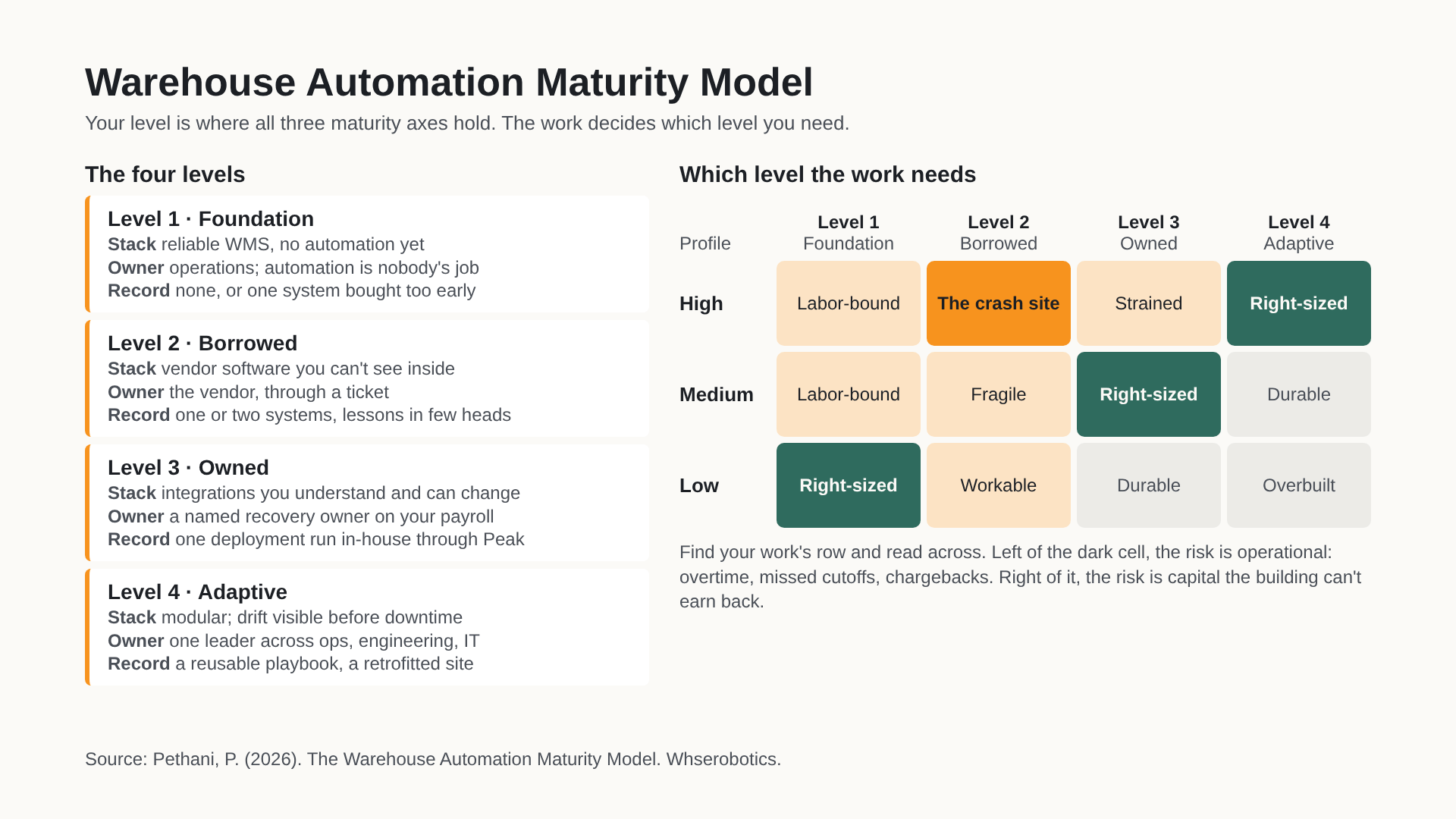
Higher isn’t automatically better. Operating profile tells you the level the work needs; the other three axes tell you where you are today. If the work is simple, a lower level can be exactly right.
The four levels
Level 1: Foundation
The basics get put in place before automation. When volume swings, people absorb it, and you pay in overtime, temp labor and missed cutoffs.
- Tech stack: a WMS with reliable inventory and location control, no automation integrations yet.
- Ownership: operations owns the process; nobody’s job is automation.
- Track record: none, or one system bought before the ground was ready.
You’re probably here if a stopped robot would leave the floor unsure who to call.
Level 2: Borrowed
The site bought a system to fix a bottleneck. The robots are under your roof, but the know-how to run and fix them belongs to someone else, and the space between operations, maintenance and IT belongs to nobody. Recovery happens on the vendor’s timeline.
- Tech stack: the WMS plus vendor control software the site can’t see inside.
- Ownership: the vendor, reached through a ticket.
- Track record: one or two standalone systems, with the lessons in a few people’s heads.
You’re probably here if your first call when something stops goes to the vendor.
Level 3: Owned
The team can work around a struggling part of the system on its own, by changing how work is released and sequenced, without waiting on a vendor change order. They can tell you why the fleet slowed down, not just why it stopped. One deployment is enough to get here, as long as your team commissioned it, tuned it, got it through a Peak and wrote down why it was designed the way it was.
Owning changes also means owning safety: moving a travel path or resizing a safety zone yourself calls for a fresh risk assessment under standards such as ANSI/RIA R15.08 and ISO 3691-4. And this level costs you in people.
- Tech stack: the site understands its integrations and can change how work flows through them, direct to the WMS or through an orchestration layer.
- Ownership: a named recovery owner on your payroll.
- Track record: at least one deployment commissioned, tuned and recovered in-house.
You’re probably here if the first call goes to someone on your payroll, and they can fix it.
Level 4: Adaptive
What the floor learns changes the design. Workarounds become official process instead of being tolerated, and cost per order swings a lot less.
- Tech stack: modular enough to swap a vendor without starting over, with drift visible before it becomes downtime.
- Ownership: an automation leader with authority across operations, engineering and IT.
- Track record: a reusable playbook, and at least one site retrofitted when its work changed.
You’re probably here if last year’s workarounds are in this year’s system rules.
Maturity against complexity
The matrix crosses the four levels with operating profile. Find the row that matches your work and read across: that’s the level the work needs. To the left of it, you’re under-built and pay in overtime, missed cutoffs and chargebacks. To the right, you’ve spent capital the building can’t earn back.
A level can stop fitting without anything inside the building changing. A wholesale building running shuttles under a vendor contract sits comfortably at Level 2: uniform cases, stable SKUs, predictable volume. Route a new DTC customer through the same building and the work moves to a much harder row. Nobody touched the shuttle or the contract, but Level 2 on that row is where operations break.
“Overbuilt” refers to the tech stack, not people. An orchestration layer over two systems that could talk to the WMS directly is overbuilt. A named recovery owner is never overkill, at any level. And Borrowed can be the right call when chosen on purpose: RaaS and full-service contracts take capital and obsolescence risk off your balance sheet, but they don’t take recovery off your floor.
Place one site in four questions
- What systems govern the floor, and can anyone on site explain how they decide?
- When automation stops, who gets called first, and can they fix it without opening a ticket?
- What have we deployed, and where did we write down what we learned?
- How variable is the work: order mix, SKUs, volume swings, building constraints?
The first three place you on the levels; the fourth tells you which level you need.
What I keep seeing
- Most organizations think they’re one level higher than they are.
- Sites in the same company are often at different levels.
- The most expensive mistake is a Level 1 organization buying Level 3 technology.
- The move from Level 2 to Level 3 gets treated as a hardware decision. It’s really about taking over the handoffs.
Every automation business case puts a price on the robot. Very few put a price on who will own it after the vendor’s team leaves.
Common questions
How is this different from other warehouse automation maturity models?
Most published models score the technology installed. This one scores whether the organization can run and change what it bought, and it adds operating profile so the target level depends on the work, not on a ladder.
Does Level 4 mean fully automated?
No. Level 4 describes how the organization learns and changes, not how many robots it runs. A site with modest automation can be Adaptive; a highly automated site can be Borrowed.
Do I need an orchestration layer?
Operating profile decides. One or two systems integrated directly to the WMS usually don’t need one. It earns its place when the work is complex enough that several systems have to be coordinated.
How do I rate a multi-site network?
Rate each site separately. Sites in the same company are often at different levels, and a single network score hides the building that will fail first.
How to cite
Pethani, P. (2026). The Warehouse Automation Maturity Model. Whserobotics. https://whserobotics.com/maturity-model
The model came from buildings I’ve been in, not a survey, and it’s still being tested. If you place a site and it doesn’t fit, I want to hear about it. The full write-up appeared in Warehouse Robotics Insights, one insight on warehouse automation and robotics every Sunday.